


Drones are no longer just the toys of tech enthusiasts or the eyes in the sky for filmmakers. They’ve swooped into the agricultural scene, transforming how farmers manage their fields. Imagine having a bird’s-eye view of crops without needing to climb a tree or hire a helicopter. That’s the magic of drones in agriculture.
Overview of Drones in Agriculture
Drones play a pivotal role in modern agriculture, evolving into indispensable tools for farmers. Their unique capabilities significantly enhance crop monitoring and management.
Definition and Types of Agricultural Drones
Agricultural drones refer to unmanned aerial vehicles designed to assist in farm management. Various types exist, including fixed-wing drones, rotary drones, and hybrid models. Fixed-wing drones excel in covering large areas quickly, while rotary drones offer precise maneuverability for close-up inspections. Hybrid models combine features of both, balancing speed and precision. This diversity allows farmers to select drones that best suit specific operational needs.
Benefits of Using Drones in Agriculture
Utilizing drones in agriculture enhances efficiency and reduces time spent on various tasks. Drones facilitate aerial imagery, enabling farmers to monitor crop health effectively. They assist in soil analysis, providing data on moisture levels and nutrient content. Precise application of fertilizers and pesticides becomes achievable through drone technology, minimizing waste. Furthermore, drones help identify crop diseases and pests early, allowing for timely intervention. These advantages contribute to increased crop yields and sustainable farming practices.
Applications of Drones in Agriculture
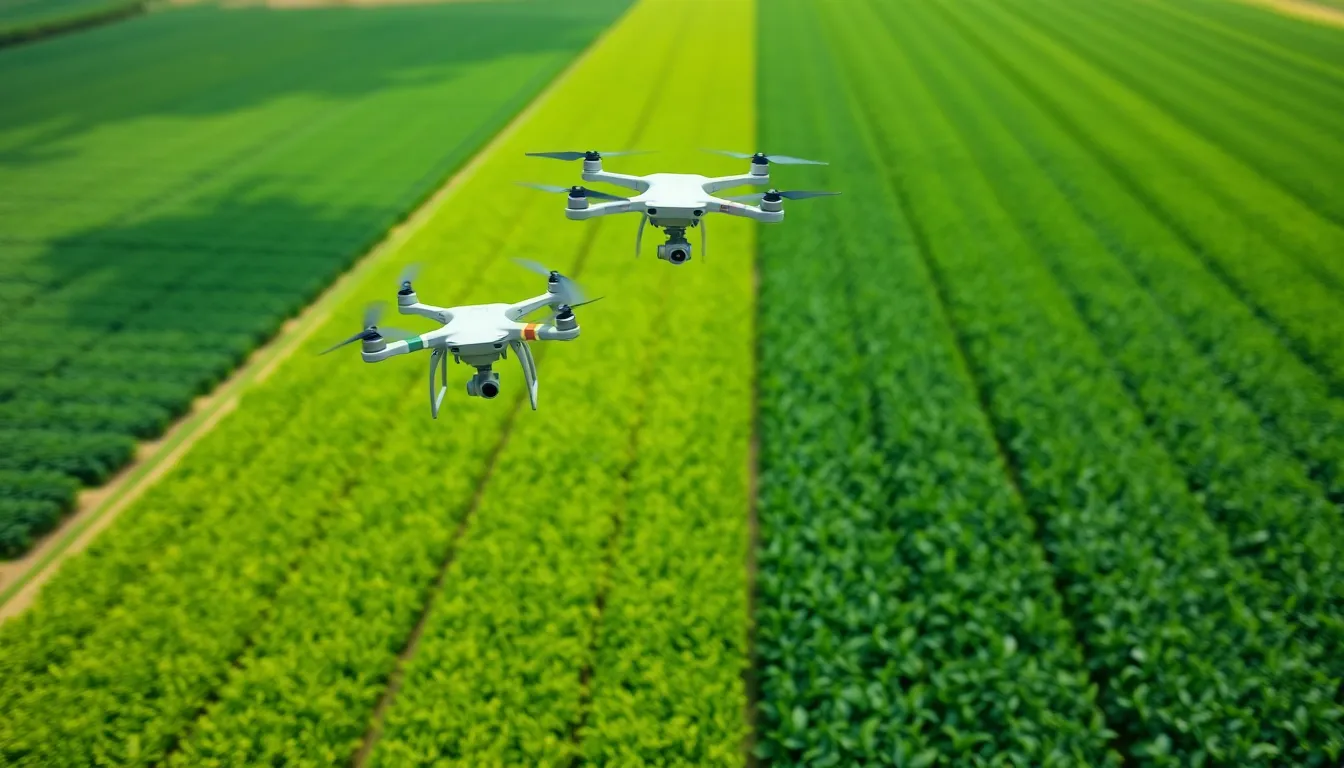
Drones play a crucial role in modern farming by offering innovative solutions for various agricultural tasks. Their applications enhance productivity and sustainability.
Crop Monitoring and Health Assessment
Drones enable farmers to monitor crops from above, providing real-time data on plant health. Aerial imagery reveals patterns that indicate stress and disease presence. Farmers can identify nitrogen levels, water issues, and pest infestations quickly, which minimizes loss. Using multispectral and thermal cameras, drones can assess plant conditions more accurately than ground methods. Regular monitoring helps in implementing timely interventions, ensuring robust plant growth.
Precision Farming Techniques
Precision farming benefits significantly from drone technology. Drones facilitate targeted application of water, fertilizers, and pesticides, reducing waste and improving efficiency. Specific areas of a field can receive tailored treatment based on aerial analyses. Its ability to map soil variability allows farmers to optimize input use, ultimately maximizing yields. Implementing data-driven decision-making leads to enhanced resource management and cost-effectiveness, securing better returns on investment in agriculture.
Challenges and Limitations
Drones in agriculture face several challenges and limitations that can hinder their widespread adoption. Understanding these issues is crucial for effective integration into farming practices.
Regulatory Restrictions
Governments impose regulatory restrictions on drone usage that can complicate agricultural applications. Operators must navigate the legal landscape, which varies by region and often requires permits. Specific regulations dictate altitude limits, no-fly zones, and pilot certification. Compliance with rules from organizations like the FAA in the United States remains essential for legal operation. Additionally, farmers need ongoing education about evolving policies to ensure adherence and avoid potential penalties.
Technical Limitations
Technical limitations also affect the effectiveness of drones in agricultural settings. Battery life contributes significantly to operational constraints, as most models can only fly for 20 to 30 minutes on a single charge. Data processing capabilities create challenges; significant data collection requires robust software and hardware for analysis. Weather conditions further impede drone performance, with high winds or rain often grounding flights. Lastly, the high cost of advanced models can deter adoption, especially among small-scale farmers.
Future Trends and Innovations
Innovations in drone technology redefine agricultural practices, driving efficiency and productivity. These advancements address limitations and enhance capabilities for farmers.
Advancements in Drone Technology
Flight autonomy improves significantly, allowing drones to operate with minimal human intervention. Enhanced sensors provide higher-resolution images and data analytics. Battery life increases, enabling longer flight times and broader coverage. New materials reduce weight and improve durability, leading to increased resilience in fields. Collaborative swarm technology allows multiple drones to work together on large-scale tasks, optimizing field management processes. These advancements collectively enhance the overall utility of drones in modern agriculture.
The Role of Artificial Intelligence
Artificial intelligence plays a transformative role in agricultural drone applications. AI algorithms analyze vast amounts of data, offering insights that humans may overlook. Machine learning enhances crop health assessments by identifying patterns in aerial imagery. Predictive analytics enables farmers to make data-driven decisions, optimizing resource allocation. Automated systems empower drones to make real-time adjustments during flights, improving precision in operations. The integration of AI with drone technology fosters adaptive farming, ultimately leading to increased sustainability and productivity.
Drones are transforming agriculture by providing farmers with innovative tools to enhance productivity and sustainability. Their ability to monitor crops from above and deliver real-time data is revolutionizing traditional farming methods. With advancements in technology and the integration of AI, the future of agricultural drones looks promising.
While challenges remain in terms of regulations and costs, the benefits of using drones far outweigh the limitations. As farmers continue to embrace this technology, they can expect improved crop yields and more efficient resource management. The journey of drones in agriculture is just beginning, paving the way for a smarter and more sustainable farming landscape.